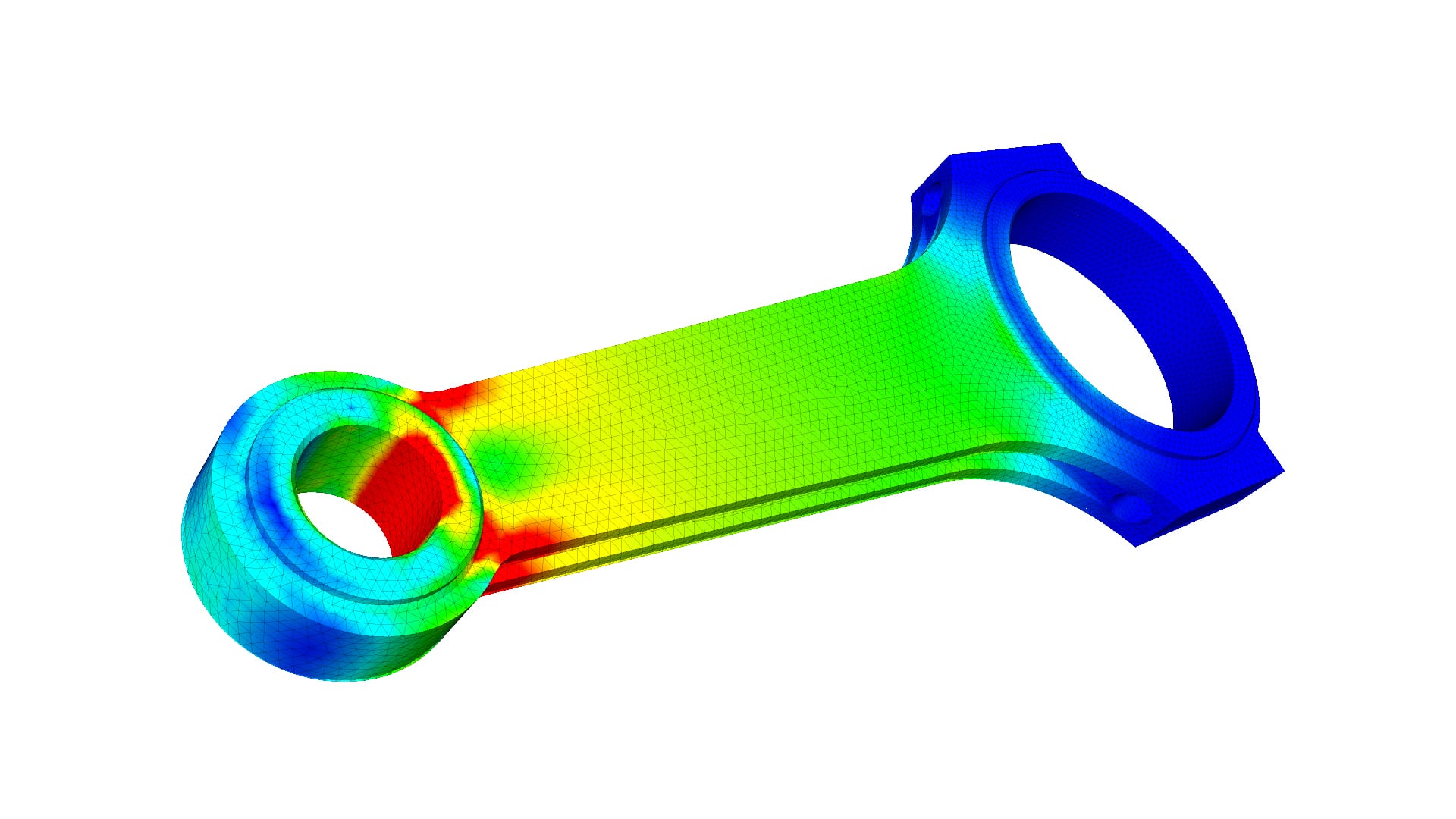
Finite Element Analysis in Structural Engineering
Methods, Applications, and Best Practices
1FEA Fundamentals
The finite element method divides a continuous structure into discrete elements connected at nodes. By solving equations for each element, we can approximate the behavior of the entire structure.
Core Concepts:
- Discretization: dividing geometry into finite elements - Shape functions: interpolating displacement within elements - Stiffness matrix: relating forces to displacements - Assembly: combining element matrices into global system
Governing Equation:
[K]{u} = {F} Where: [K] = Global stiffness matrix, {u} = Nodal displacements, {F} = Applied forces
2Element Types and Selection
Choosing the appropriate element type is critical for accurate results. Different elements are suited for different structural behaviors.
1D Elements:
- Beam elements: bending and axial behavior - Truss elements: axial forces only - Spring elements: point-to-point stiffness
2D Elements:
- Shell elements: thin-walled structures - Plane stress: thin plates in-plane loading - Plane strain: thick structures with out-of-plane constraint
3D Elements:
- Tetrahedral: complex geometries - Hexahedral: regular shapes, higher accuracy - Wedge elements: transitions
3Mesh Generation and Refinement
Mesh quality directly impacts solution accuracy. A well-designed mesh captures stress gradients and geometric features effectively.
Mesh Quality Metrics:
- Aspect ratio: ideally close to 1 - Skewness: minimize distorted elements - Element size: balance accuracy vs. computation
Refinement Strategies:
- H-refinement: increase number of elements - P-refinement: increase polynomial order - Adaptive meshing: automatic refinement based on error
Best Practices:
- Refine near stress concentrations - Use transition elements between fine and coarse regions - Verify mesh convergence through successive refinement
4Boundary Conditions and Loading
Proper application of boundary conditions and loads is essential for realistic results.
Support Types:
- Fixed: all DOFs restrained - Pinned: translations restrained, rotations free - Roller: single translation restrained - Spring supports: elastic restraints
Load Types:
- Point loads: concentrated forces - Distributed loads: pressure, body forces - Thermal loads: temperature gradients - Dynamic loads: time-varying forces
Common Mistakes:
- Over-constraining models - Applying loads at single nodes instead of distributed - Neglecting load paths
5Results Interpretation and Validation
Critical evaluation of FEA results ensures reliable design decisions.
Key Results:
- Displacements: deformed shape and magnitudes - Stresses: Von Mises, principal stresses - Reactions: support forces for equilibrium check - Strain energy: identify load paths
Validation Methods:
- Hand calculations for simple cases - Benchmark problems with known solutions - Convergence studies - Equilibrium verification
Warning Signs:
- Stress singularities at sharp corners - Asymmetric results in symmetric problems - Unrealistic displacements - Poor convergence
Conclusion
Mastering finite element analysis requires understanding both the theoretical foundations and practical application considerations. While powerful software tools are available, the engineer's judgment remains essential for creating appropriate models, selecting proper elements, and interpreting results correctly. Continuous learning and validation against known solutions are key to developing FEA expertise.
Need expert FEA consulting for your project? Contact CW Structura Intelligence for advanced structural analysis services.
Contact UsAbout the Author

Lens Wolph Kenley Ciceron
Lens Wolph Kenley Ciceron is the founder of CW Structura Intelligence, bringing expertise in structural engineering, construction strategy, and AI-driven innovation to the global engineering community.